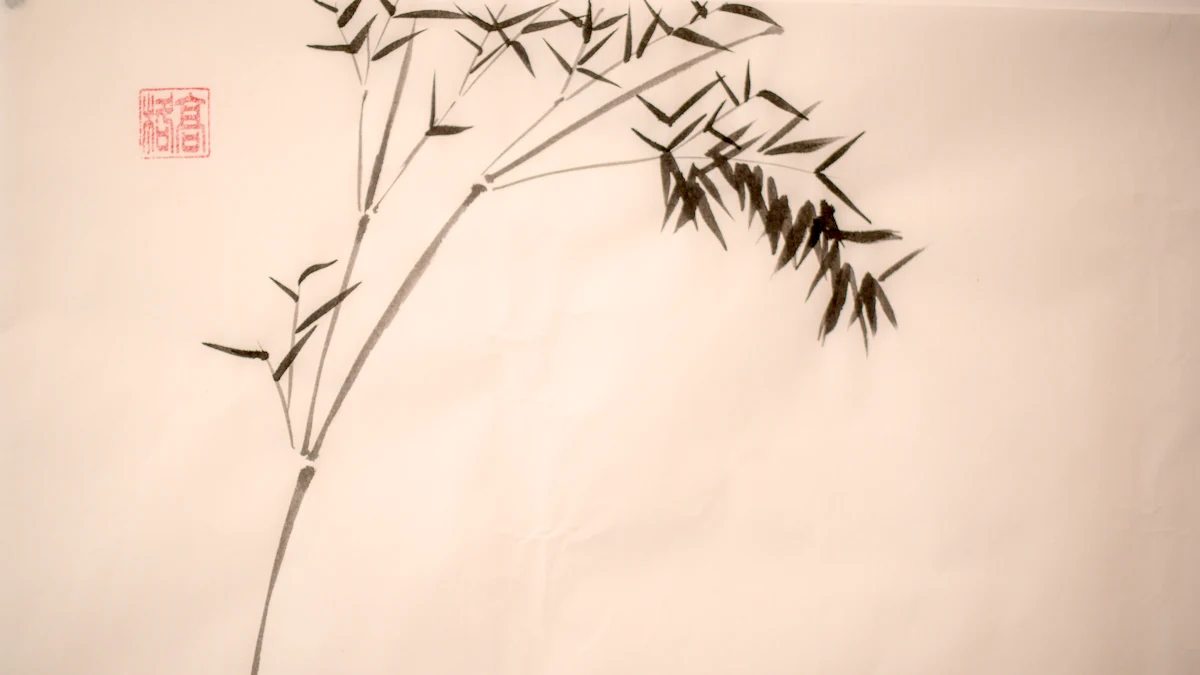
The hardest thing in a Chinese ink painting is the part that isn’t there.
Look at a Bada Shanren. One fish, a handful of strokes, and most of the sheet left as bare paper, and the paper’s doing more work than the fish. It’s water, or sky, or the fish’s own loneliness, depending on the day you look at it. He didn’t run out of ink. He ran out of things worth adding, and he stopped. That’s the skill, and it’s the one the machines can’t do for you, because they never run out.
Leaving white
Chinese has a word for it, 留白, liúbái, leaving white, and a maxim that goes with it, 计白当黑, jì bái dāng hēi, count the white as black. The blank space gets judged as harshly as the strokes, because it’s part of the painting, painted by being left alone.
Xie He, writing in the sixth century, set down six principles for judging a painting. The first, 气韵生动, qìyùn shēngdòng, usually translated as spirit resonance, is the one everyone quotes, and nobody has ever got there by adding something. It’s a quality of the whole, and the whole includes the paper.
I learned this slowly. I started painting before I moved to China, through a correspondence course run by an art institute in Kuala Lumpur. I’d post off my orchids and bamboo and wait for the verdict to come back, an arrangement I still think of as the most Victorian thing I’ve ever done. The curriculum is the one every student of the tradition gets, the Four Gentlemen, plum, orchid, bamboo and chrysanthemum, for years. What bamboo teaches is that the leaves you don’t paint are the wind. Paint every leaf and you’ve got a botanical drawing. Leave the right ones out and the stem starts to move.
I’m still not very good at it, and the thing I’m worst at is stopping. The bamboo at the top of this page is one of mine, from September. Every sheet gets to a point where one more leaf looks as if it would help, and nearly every time it wouldn’t. My rule now is to stop one leaf early. It’s the most reliable rule of composition I’ve found, and I’ve never seen it in a productivity book.
We fill because filling is free
The Western habit is to fill. Fill the slide, the page, the hour, the form. It was never a great habit, but until recently it was at least an expensive one. Filling took time, and the time it took kept documents short.
The machine has taken the cost away. A model will fill anything, instantly and plausibly, for nothing, and it does, because that’s what it’s for. You can see the results in every inbox. The forty-slide deck with no subject, which in painting would be called a wall. The report that answers every question except the one that was asked. The email with four paragraphs of background before a request that could have been one line. The calendar with no white on it at all.
I don’t think the machine’s to blame for any of this. Effort used to limit how much got added, and the effort’s gone, so the only limit left is judgement. That’s the same judgement Bada Shanren was using when he stopped at one fish.
When adding things costs nothing, taking them away becomes most of the job.
Three places to take things away
In a sentence. Nearly every sentence has a leaf that seems to help, and the sentence is better without it. What needs cutting is usually a qualifier, a second adjective, or a clause explaining what the clause before it already showed. Try writing a paragraph and then taking one thing out of every sentence. It almost always comes out clearer, and I’ve never had a reader complain that it was too short.
In a plan. The most important line in a plan is the thing you’ve decided not to do, and most plans leave it out, because deciding against something feels like losing it. My year runs in seasons of about three months, each with one main focus and everything else parked with a date on it. This autumn the focus was losing weight, and painting was one of the things parked. From November it’ll be martial arts. Nothing gets abandoned, it just gets a date, and that’s the difference between white space and a gap. A plan with no white on it is a wall, and walls don’t move.
In a system. Every field on a form is a promise that someone will look at it. I’ve built enough forms in my working life to know that a field nobody reads isn’t free. It costs the person filling it in, it costs whoever maintains it, and it costs the one field that did matter, which is now harder to find. The most useful review I know for any system is to go through every field, column and report and ask what would break if it were white. Most of the time the honest answer is nothing, and the sheet’s better for it.
The one-fish test
If you only want one tool, ask whether the page could survive with just one thing on it.
For a slide deck, if you could only show one slide, which would it be? If you can’t say, the deck hasn’t got a subject, and more slides won’t give it one. For an email, what’s the one thing you’re asking for? Put it in the first line and let the rest be white. For a day, what’s the one thing that would make it a good day if you got it done? Do that first and let the errands be the wind.
The test won’t tell you what to add. It tells you what the fish is, and once you know that, everything else becomes negotiable, and most of it ends up white.
What the machine can’t run out of
I use a model as an editor most weeks, and it’s very good at one particular job. Ask it what’s redundant and it’ll find the repeated clause, the second example that adds nothing, the paragraph that says what the heading already said. It’s a superb hunter of leaves.
Ask it what the fish is, though, and it can’t tell you. What matters on this page, to this reader, coming from you, has to be decided, and decisions get made by a person with the brush in their hand. The machine can paint every leaf on the stem, but it can’t decide which ones are the wind, because it never runs out, and running out is where composition starts.
So the division of labour is a good one. Let the machine fill, and let it cut the redundancy, because it does both better than you. Keep the fish for yourself. Decide what the page is about, and then do the hard part, which is stopping.
A page with one fish on it is finished, because someone decided it was.