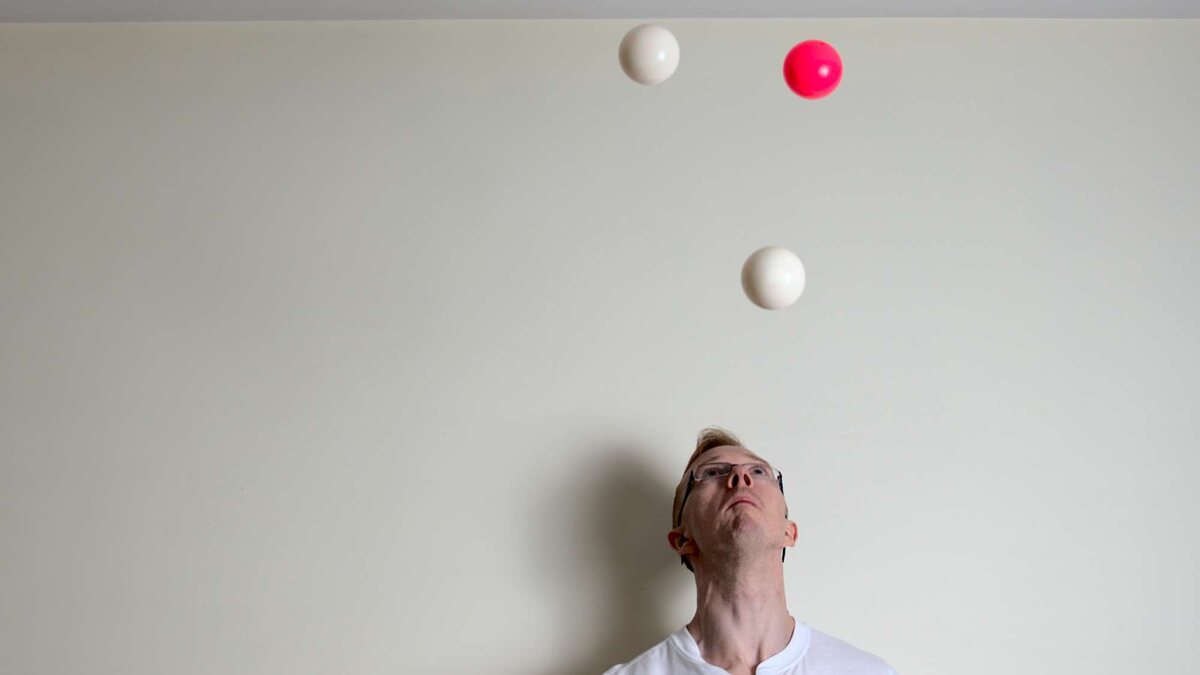
We are looking at a point in the air where each throw peaks, and we are not looking at our hands at all, and the moment we do, everything is on the floor. This is the first thing you learn, usually the hard way, and it took me thirty years to notice that it is not about juggling.
Look at the peak
I learned to juggle at ten, at the circus camp I attended every Summer, and for a fortnight I did what every beginner does, which is watch my hands. My hands were where the balls were. It seemed the obvious place to look. And for a fortnight the balls hit the lawn in every combination the laws of physics allow, until one afternoon, for no reason I could name, I looked up instead, at the top of the arc, and the pattern held. It held because I had stopped chasing catches and started watching throws, and everything I know about the craft descends from that one change of gaze.
The peak is where the information is. A ball at the top of its arc tells you everything about where it will land and when, and it tells you in time to do something about it. A ball in your hand tells you nothing except that you caught it, which you already knew. So the eyes go to the peak, and they stay there, and the hands, left alone, do a better job than they ever did when supervised.
I have taught a fair number of people to juggle at kitchen tables over the years, and the only instruction that has ever worked is the same one: stop looking at your hands. Nobody believes it. Everybody, eventually, has to.
Every drop is a bad throw two seconds earlier
The second law of juggling is the one I would put on the wall of any office, and it goes like this. You never fix a catch. A drop is not a failure of the hand that missed it; it is a failure of the throw that put the ball somewhere the hand could not be, two seconds earlier, and the only useful correction is to the throw.
This changes what a drop is. To a beginner a drop is an embarrassment, and he tries harder to catch. To a juggler a drop is data, and he asks which throw was wrong. Too high, and the pattern slows and the timing goes. Too far forward, and you are chasing it across the room. Too early, and two balls arrive at once. Each fault has a signature, and the signature was visible at the peak, and the whole practice is a loop: throw, watch the peak, read the drop, adjust the throw. A juggler who does not count his drops is a man throwing things about. I count mine. My current standard with five balls is a clean run of fifty catches, logged, and the number is not the point; the counting is.
You may already see where this is going, but stay with the balls a moment longer, because there is one more law.
You juggle the rhythm, not the objects
A three-ball cascade is not three balls. It is one rhythm, a figure of eight in the air, and the balls are merely what is riding it. This is why a good juggler can swap balls for clubs or rings or fruit without learning anything new: the pattern does not care what is in it. It is also why four balls is not “three balls plus one”: four is two separate circles, one in each hand, a different pattern with a different count, and the beginner who tries to add a fourth ball to his cascade discovers that he has to learn a new rhythm rather than extend the old one.
And five, the number that makes people at parties go quiet, is not five objects. It is a cascade thrown higher, to a peak you can still see, at a count you can still hold. The height is the whole secret. A pattern is a decision about how high to throw, and everything else follows from the height: the tempo, the number, the margin for error. You can only juggle what you can watch peak.
Most management is watching catches
Now the transfer, which is the reason I am telling you any of this.
Multitasking is not switching. Everyone who has tried to do two things at once by alternating between them knows that alternation is where the drops come from. What the people who genuinely handle many things are doing is juggling: they have a pattern, with a height and a count, and they watch the peaks. The report is in the air; it will land on Thursday; they know this because they watched it go up. The difficult conversation is in the air; it peaks on Friday. Nothing is being caught by lunging. The eyes are up.
And the manager who is drowning is, nearly always, watching his hands. He inspects outputs: the report when it lands, the dashboard, the number at the end of the month. When something drops he tries harder to catch, which means more inspection, more meetings, more asking to see the thing before it is finished. But the drop was a bad throw two weeks earlier: a brief that did not say what done looked like, a delegation with no date on it, a project launched at a height nobody could see. The correction is in the throw, and it was available at the time, at the peak, to anyone who was looking up.
This year the transfer has become urgent, because the machines have changed the arithmetic. You can now throw far more than you can catch. Drafts, messages, analyses, agents, all of them launched in a sentence and all of them landing on your desk for review. The failure mode is obvious once you have held five balls: people spend the whole day catching, reviewing every output as it arrives, and call it diligence, and it is a beginner staring at his hands. The work moved. It is in the throw now, in the instruction, the constraint, the example, the definition of done, and in the pattern: how many things you have in the air, at what height, on what count. I direct machines for a living, and the drop rate went down the week I stopped inspecting catches and started fixing throws.
Pick your number
There is a limit, and it is worth being honest about it, because the productivity trade never is.
Five balls is where most human beings stop, and the reason is not the hands. It is the height. Six needs a peak higher than most people can watch and a count faster than most people can hold, and the pattern collapses not at the catch but at the eyes. The limit on what you can juggle is the limit on what you can see peak.
So the question is never how many things you can handle. It is how many you can watch. Pick that number, throw to a height you can see, count, and let the hands alone. Everything above that number is not ambition. It is tennis balls on a lawn.
Watch the peak. Fix the throw. Count.