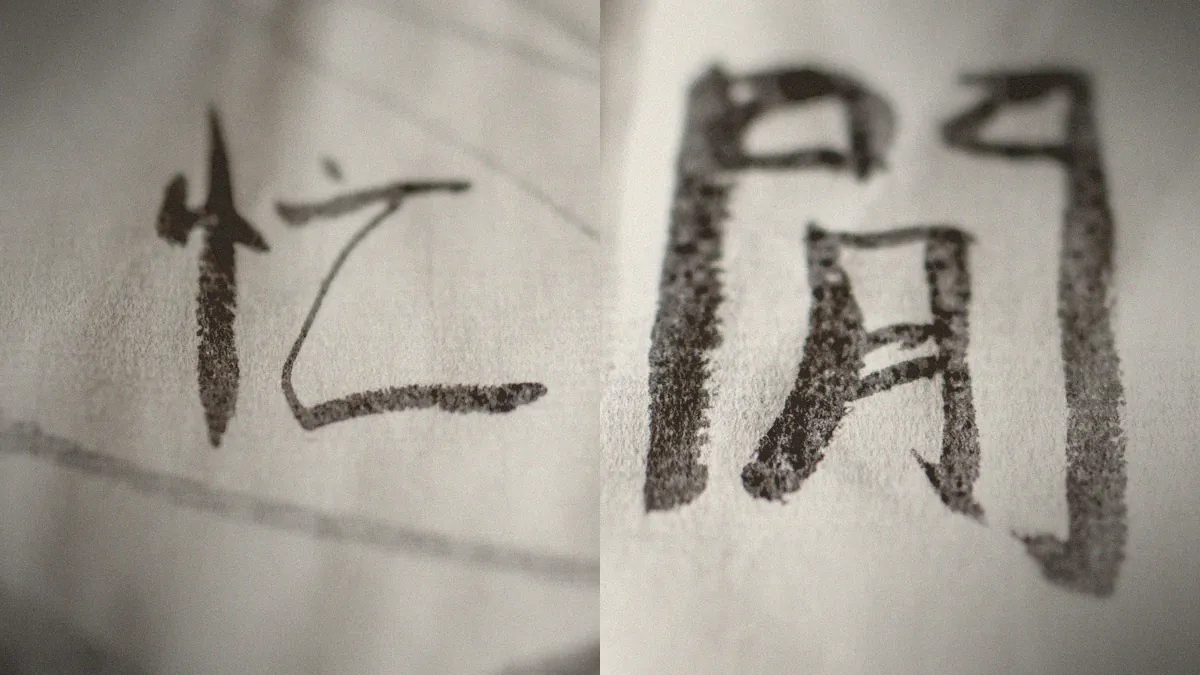
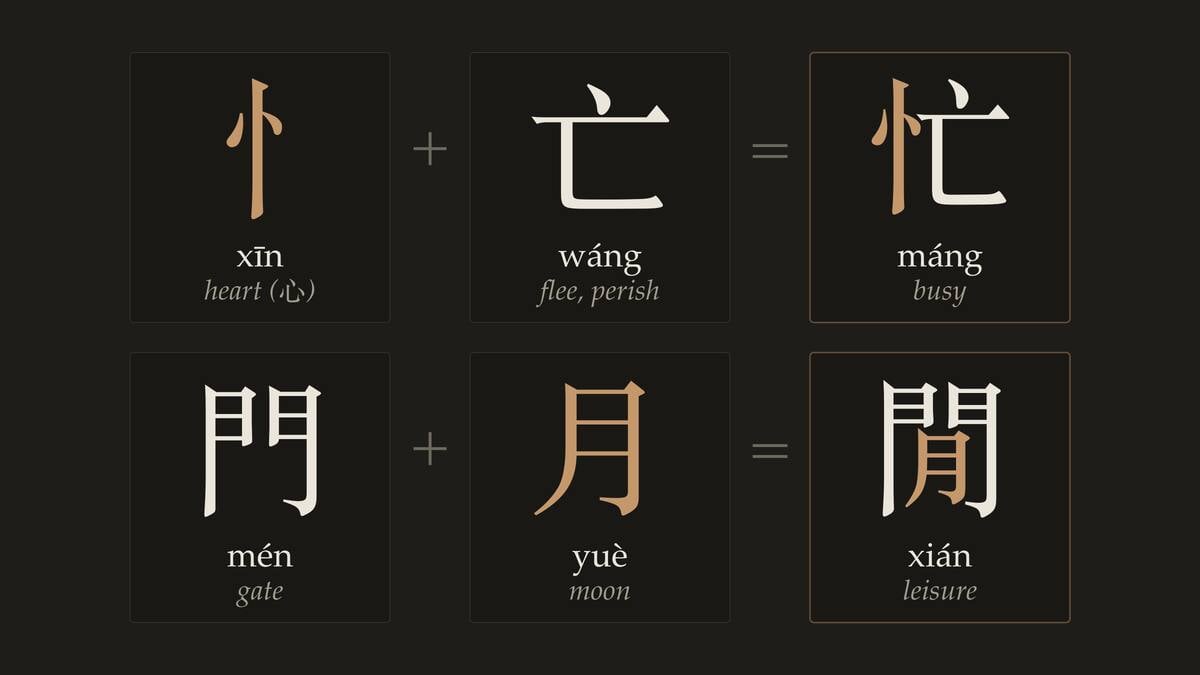
The Chinese character for busy is 忙, máng. On the left is 忄, the heart. On the right is 亡, which means to lose, to flee or to perish, depending on which dictionary you pick up.
The character for leisure is 閒, xián. It’s a gate, 門, with the moon, 月, inside it.
People who know more about this than I do will tell you the 亡 is only there for its sound, and they’re right. It doesn’t change much for me. Whoever first wrote a heart beside it was describing something everyone knows, the feeling you get at your desk around four in the afternoon.
A heart on the run
I’ve read Chinese every day for twenty years, and one habit that comes with that is seeing characters in their parts. 忙 is the one I notice most, because it’s the one people say most. In China, 最近忙吗, “busy lately?”, does the job that “how are you?” does in English. The answer is nearly always yes, and the character in it is a heart on the run.
What I like about it is what’s missing. There’s no clock in 忙, no calendar, no list. Busy isn’t described as a full diary. It’s described as a state you’re in. I’ve had weeks with every hour booked when I didn’t feel busy at all, and some of them were among the best weeks I’ve had. I’ve also had empty Sundays when I couldn’t sit still for ten minutes. You’ve probably had both.
That’s why so much of the advice about being busy doesn’t stick. Clear the diary, learn to say no, delegate, block out time. It’s all aimed at the schedule, and the schedule was never really the problem. Some of it just makes the running more efficient.
The hours came back
This year has been a good test of the idea. AI has handed a lot of people a lot of time back. Work that used to take an afternoon now takes a few minutes, and on paper the afternoon is free.
Most people I know who’ve had that time back are exactly as busy as they were before. Some are busier. The time came back and the rush moved straight into it. If being busy lived in the calendar, an emptier calendar would have fixed it, and it hasn’t.
A gate with the moon in it
So it’s worth looking at the other character, because I think it has the answer, and it’s more exact than the English word.
閒 is more specific than free time. Free time on its own is just the same restlessness with nowhere to go, which is why plenty of people come back from a holiday more tired than they left. The character is a gate with the moon in it, and there are three parts to that. You need all three.
The gate is a boundary: a room, a door you can close, a time that comes round again. The opening is the time itself. And the moon is what the time is for, something that’s worth the light.
Mine is a brush and an ink stone on a Saturday morning, and it has been for years. Yours could be a form in the garden before anyone else is up. A pot of tea you actually pay attention to. A book. A walk with someone you’d rather not be without.
The simplified character used in mainland China, 闲, swaps the moon for a tree, 木. Same idea, different picture. I’ve always preferred the moon, because the moon only turns up at a certain time, and so does leisure.
Build the door
If there’s a practice in this, it goes in an order, and the order matters.
Start with the gate. A boundary rather than an hour: a door that shuts, a time that repeats, the phone in a drawer. People who try to fit leisure into an open calendar usually find it gets swallowed along with everything else, because nothing marked it off.
Then the time. It doesn’t have to be long. You don’t need a big window to see the moon.
Then the moon. Put something in that time that’s worth it, because an empty gap won’t hold you for long. You’ll fill it with something else within a minute. What gets you to stop is having something there to stop for.
Nobody stops being busy by emptying the diary. In my experience you stop by building one door, standing in it at the right time, and staying long enough to notice that, for a while, there’s nothing you need to run from.