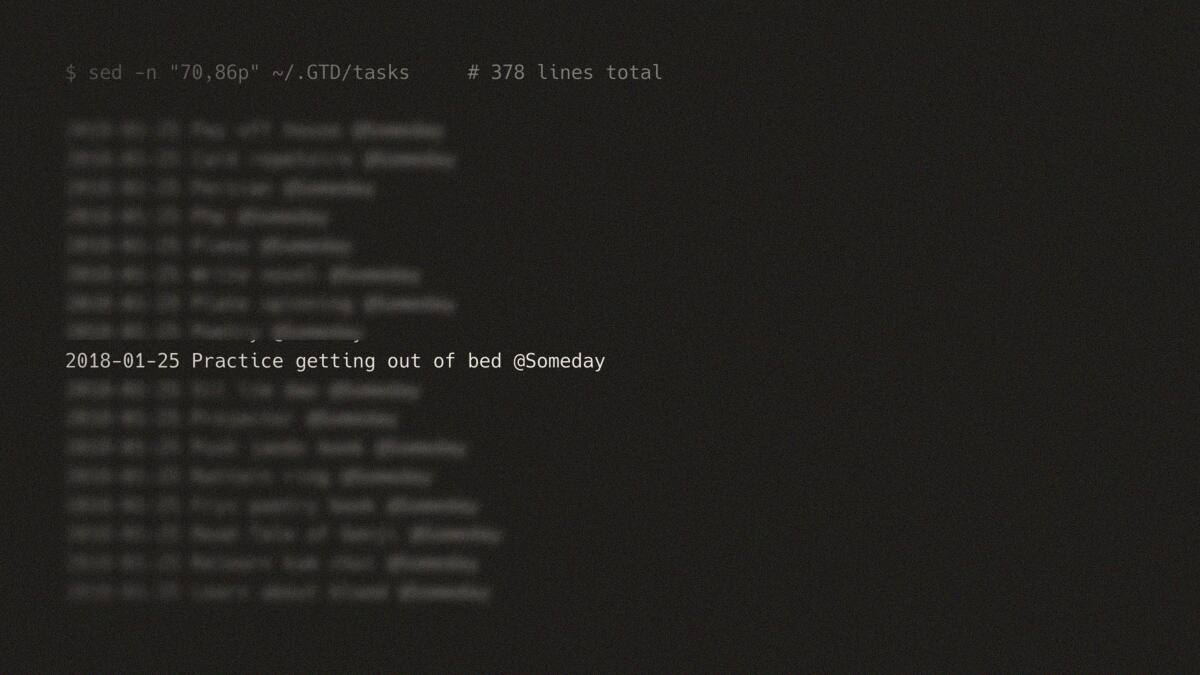
For at least eight years, my to-do list told me to practise getting out of bed.
That’s a real entry. “Practice getting out of bed”, tagged Someday. Its date says January 2018, but that’s only when it moved across, in a batch from the system I’d used since 2009, so I honestly don’t know how old it is. It was still there this summer, not started, a long way down a list I’d kept with real discipline for well over a decade. I’ve run my life on Getting Things Done for twenty years, so I can tell you my system did exactly what a trusted system is supposed to do with that line. It remembered it. It carried it faithfully through a move from China back to England, and at no point did it ask how the practising was going.
By the end the list ran to nearly four hundred lines. A Chinese book I’d wanted ten years earlier and still haven’t bought. Finish Moby-Dick, from disc ten. JNCO jeans, which I can only put down to a weak moment. I meant every one of them when I wrote it down. But a list with no limit will take on more lives than one person can live, and then hold every one of them against you.
And at some point I noticed that opening the list didn’t feel like anything any more. I’d go in looking for something dull, a phone number or a reference, and hundreds of things I’d once properly wanted would slide past, and I’d feel nothing at all. I’d have welcomed a bit of guilt, frankly, since guilt at least means something’s still connected. This was more like reading the terms and conditions of my own life.
We’ve all got words for a task system that fails loudly, the missed deadline and the apologetic email. Nobody warns you about the one that fails quietly and stays failed for years, where the list still works, technically, and means a little less every month. I think that’s the common failure, and I think a lot of lists are in it right now. I’d call it numbness. The useful thing to know is that it comes from how the list is built, so it would happen to anybody.
Two words for never
The most incriminating thing in my old list isn’t any one entry. It’s the tags.
Somewhere along the way I’d ended up with two separate tags for putting things off. One was Someday, in the orthodox GTD manner. The other was home-made, and it was called notnow. So at some point the pile of things I wasn’t doing had outgrown one category, and rather than ask why, I’d made it a second one. Getting out of bed was Someday. The jeans were notnow. I couldn’t tell you the difference, because there isn’t one. I’d just got very good at filing things I wasn’t going to do, and the filing felt like progress.
That’s what the tools train you into, and I say it as someone who loves these tools and has built a few of his own. Look at what’s easy and what’s hard. Getting something onto the list is one keystroke, or a sentence said in the car, and that’s as it should be. But now look for the way off the list, and there’s only one respectable exit, which is finishing the thing. You get a satisfying little tick for that. There’s no ceremony at all for the more honest sentence, which is “I no longer mean this”. Deleting a line feels like admitting a small defeat, so nobody deletes. We scroll past instead, and each time it gets a bit easier.
So there’s a rule you could set your watch by. Anything that’s cheap to add and awkward to remove will grow until it means nothing.
Then the screen finishes the job. Every line gets the same font and the same little checkbox. Buying that book is ten minutes. Moby-Dick is a couple of weeks of evenings. Practising getting out of bed is, as far as I can tell, a change of personality. On the screen they look identical. See them side by side at the same size every day and you stop feeling the difference, and when everything weighs the same, nothing weighs very much.
What finally got me to do something was seeing the list for what it was. A task list is not a memory aid. It’s a ledger of promises you’ve made to yourself. Mine held nearly four hundred of them, reviewed every week in the good months and kept now and then. No wonder my eyes glazed over when I opened it. I was reading my own unanswered post.
Keep everything, look at five
The first thing I tried was the obvious thing, a hard limit. My active list could hold twenty-five items, and adding a twenty-sixth meant demoting one by hand, that day. I liked it a lot. Every new commitment had a price, and paying it forced the question the endless list had been built to avoid, which is whether this new thing is worth more than the least of the things I’ve already promised.
It lasted a few weeks. The trouble was that things were getting demoted to make room, when they hadn’t stopped mattering at all. I was throwing away real information to satisfy a number.
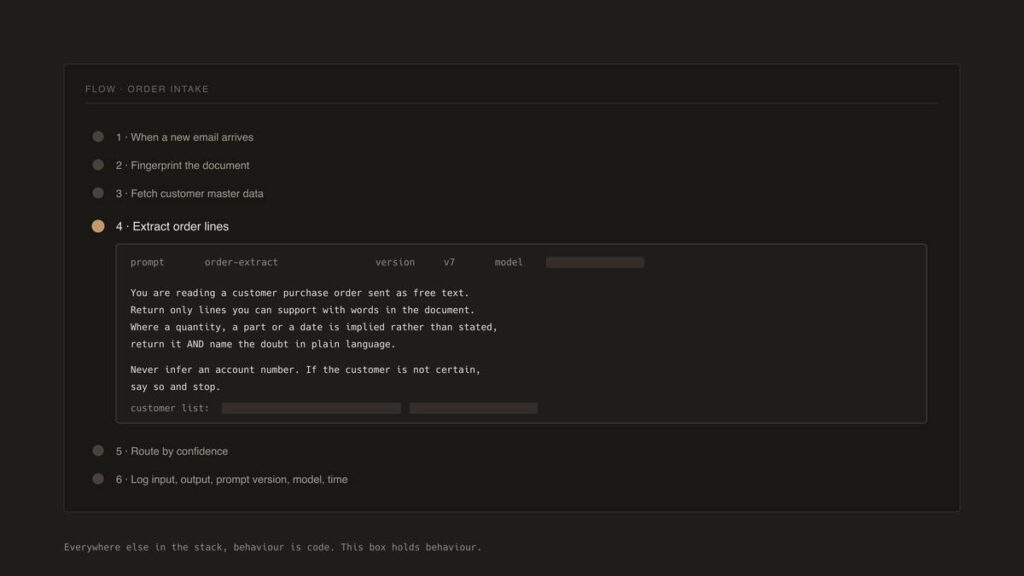
What I’d missed was where the damage was coming from. A long list does no harm sitting in a file. It does its harm when you read it, all of it, every day. So now I don’t. The list can be as long as it likes, and at the moment it’s about a hundred lines, which would have horrified me in July. But I never see it. Every morning an AI reads the whole thing for me and hands me a short numbered list for the day, in the order I should do it, and that’s all I look at. It can get through a hundred promises before breakfast without feeling a thing, which I think is the first time that’s been a qualification for a job.
You don’t need the AI for this, by the way. I used to do the same thing on a page of my Filofax: write down the day’s three to five real things, then number them in the order I’d do them, while I was still fresh enough to choose. The numbering turns out to matter more than the list. An unordered list asks you to make a decision every time you finish something, and that’s exactly when you’ve got nothing left to decide with.
So the rule underneath both is simple enough: keep everything, look at five. The list you keep and the list you look at are different things, and nearly every task app ever made has cheerfully shown you the first when you needed the second.
Two smaller habits hold it up. The first is an honest way out. A line can now leave my list without being done, archived with a note that I’ve stopped meaning it, and I treat that as bookkeeping. The second is that old ambitions come back one at a time or not at all. The worst thing the old list did was show me all of them at once, dozens of abandoned plans between me and a phone number. Nobody can face that before breakfast, so you stop feeling it, and there’s the numbness again, as a kind of self-defence. Now one old line comes back occasionally, on an ordinary morning, as a question. Do you still want this? Asked one at a time, the question means something again.
The one that came back
If any of this stung, here’s the cheap version, and it takes one evening. Tonight, write tomorrow’s five on a card, number them, and tomorrow don’t open the full list at all. Do that for a week. Then go through the long list once, and let yourself write “I don’t mean this any more” next to anything that’s earned it.
After that, pay attention to what comes back. Most of what you’ve buried you’ll never think of again, and that was weight you’d been carrying around as guilt. But one or two things will come back within days, uninvited and fairly insistent, and that’s what actually wanting something feels like. Under four hundred lines I’d stopped being able to hear it.
I’ll give you mine. In January I added a line to the old list, in among the debris: “Realign Face Dragons with who I am.” It sat there with everything else for months. It’s the one that came back, and it kept coming back until it turned into a redesign, and then into this.