If you work anywhere near a large company, you’ve probably sat through an AI demo this year, and you’ll know the moment I mean. Someone pastes in a scruffy email, the kind a real customer sends, and a second later the screen fills with a tidy order: customer, products, quantities, date. Everyone in the room leans forward a little.
The demo isn’t a trick. I’ve spent much of the last two years building systems like that one, and the reading really is that good now. What a demo can’t show you is the one question that decides whether the thing ever gets used for real, which is what happens when it’s wrong. Whether you’re being asked to put AI on orders, invoices, support tickets or anything else that acts on what it reads, that question is where nearly all the work is, and the answer to it is less glamorous than the demo and a good deal more useful.
Here’s the kind of email I mean. “Morning, can you get the usual 6 of the 4″ flanged couplers away to us, plus 2 of the big ones if you have got them. Site needs them end of the month. Same PO as last time if that is ok. Cheers, Dave.”
A model will read that perfectly. It’ll tell you Dave wants couplers, how many, and roughly when. But look at what the business needs before it can do anything with Dave’s email, and very little of it is there. There’s no account number, no part codes and no date. “The usual” only means something to whoever usually handles Dave. “The big ones” are probably the six-inch couplers, but probably isn’t the same as known. “End of the month” is most likely the 31st, and “same PO as last time” can’t be answered from the email at all.
Every company that takes orders like this has someone who turns them into the real thing without noticing they’re doing it. When one of them retires, a dictionary goes with them. And each of those gaps is a place where a machine has to guess, which is where the work begins.
Never let it guess quietly
A wrong answer that looks right is the most expensive thing an AI system can produce. An obvious mistake gets caught at the first glance. A plausible one, a sensible quantity that isn’t what Dave meant, or the right name on the wrong account, sails past every glance that would have stopped it and turns up weeks later on an invoice.
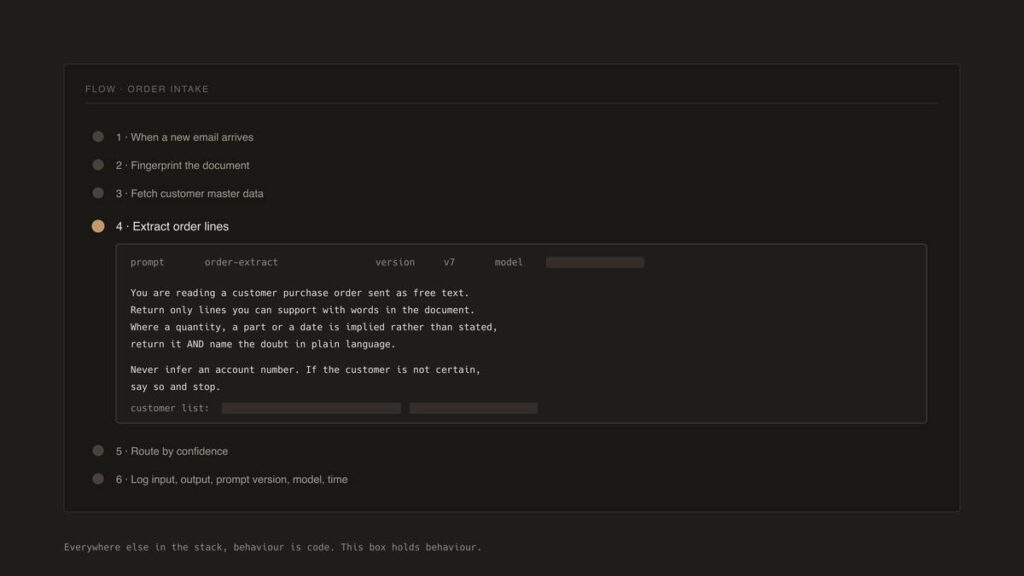
So the rule I’d defend above all the others is that the system never guesses silently. When it isn’t sure, it says so, in plain words, right there on the draft: “the big ones” read as six-inch, “end of the month” taken as the 31st, no PO found. That one rule turns a confident machine that’s occasionally, invisibly wrong into an honest one whose doubts you can see.
Decide what happens next, before it happens
Once the system is honest about its doubts, the next question sounds like bureaucracy and turns out to be most of the product: what should the business do at each level of confidence?
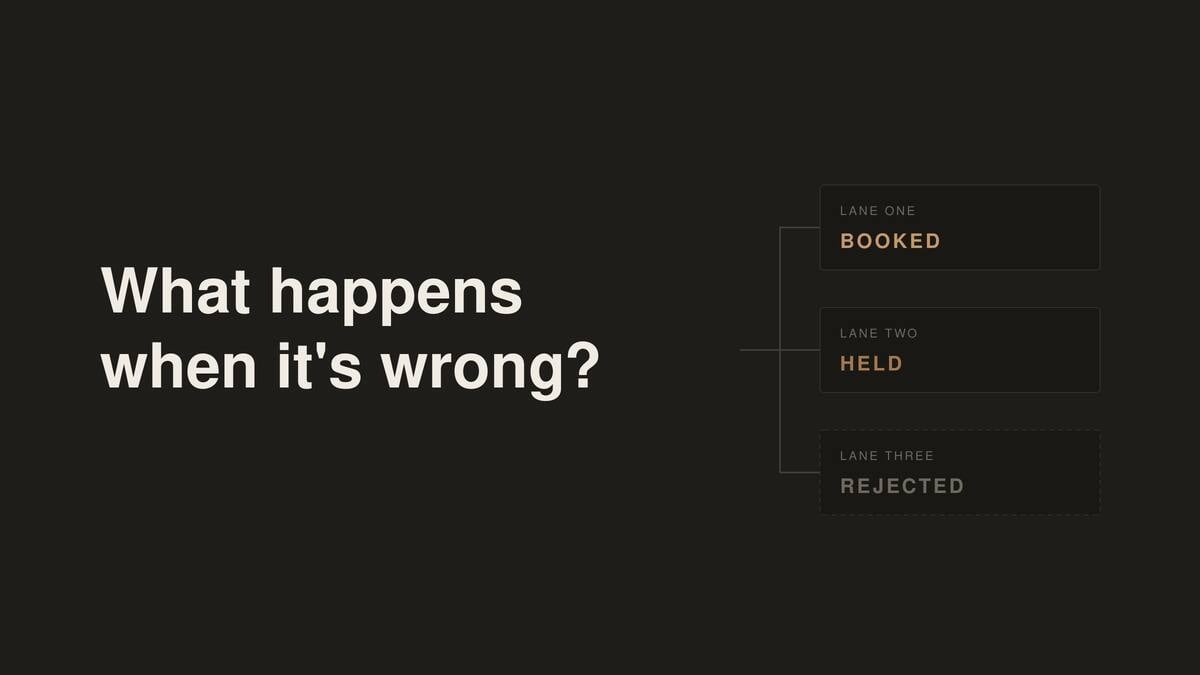
The arrangement that works, in my experience, is three lanes. A clean reading with a solid match goes straight through. A readable but uncertain one is still drafted, but held, with its doubts named, for a person to glance at. Anything the system can’t make honest sense of, or that isn’t an order at all, goes to a person with the reason attached. The model decides what the email says. The lanes decide what the business does about it, and only the second kind of mistake ever reaches a customer.
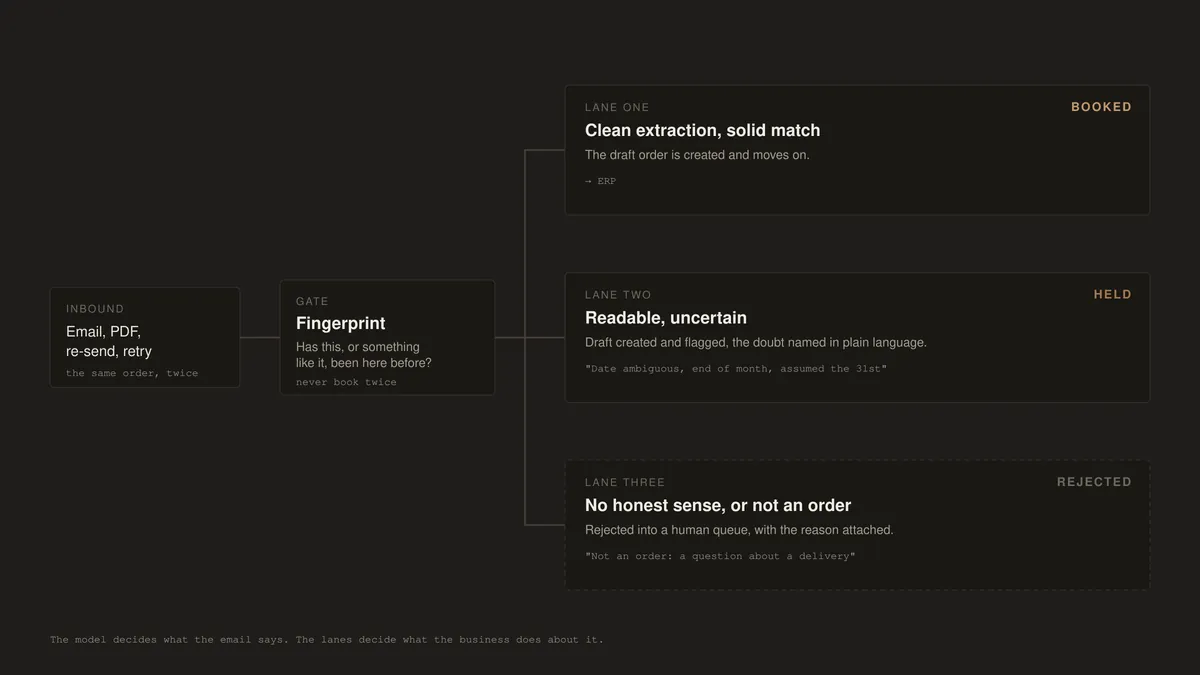
There’s one more piece that never appears in a demo, because it’s dull. The same email reaches the system more than once. It gets forwarded, or resent with “just checking this arrived”, or a connection times out and the request is retried, and the order must still be booked exactly once. So everything that comes in gets a fingerprint, and before anything acts on it, the system checks whether it has seen this, or something suspiciously like it, before.
Show the working
The last lesson was about people rather than technology. A reviewer who can’t see why the system decided something will check everything against the original email, and at that point it has saved nobody any time, however accurate it is. Accuracy that can’t be checked at a glance looks exactly like luck.
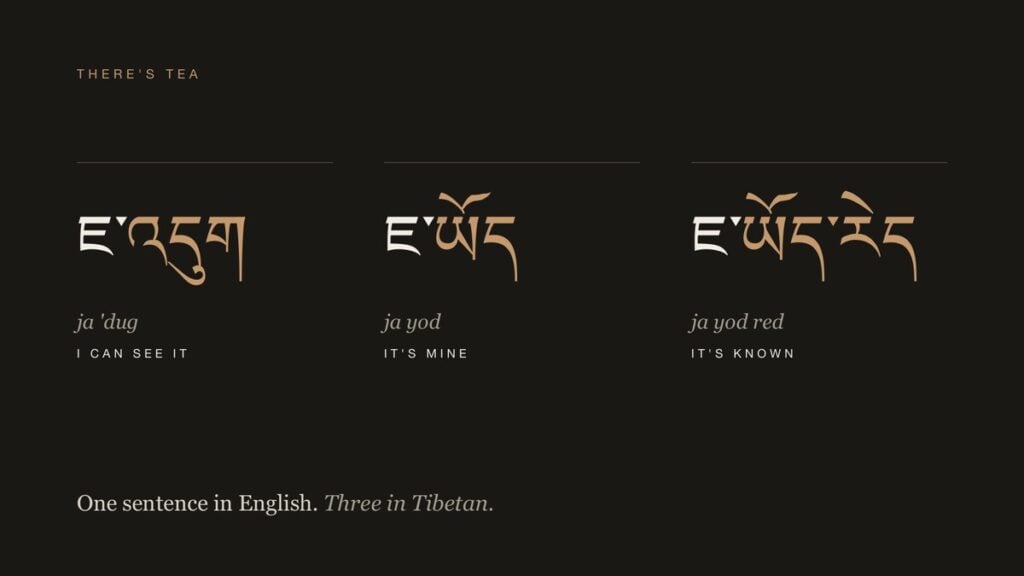
So put the evidence beside the answer: here’s the phrase that became this quantity, here’s the line I matched to this account, here’s the date I wasn’t sure of. I’ve written about the same idea from the unlikely direction of a Tibetan verb. Once people can see what the machine read and what it only inferred, they stop redoing its work and start checking it, and that’s where the time actually gets saved. People don’t trust accurate systems. They trust ones they can check.
What happens when it’s wrong
Look back at that list: honest doubts, lanes for each level of confidence, a fingerprint, and the evidence beside every answer. Not one of them is glamorous, and none of it is really artificial intelligence. It’s ordinary engineering wrapped round a few seconds of real magic, in roughly the proportion of a wedding to a kiss.
That disappointed me for a while. Then it started to look like the best news in the field. The magic is real, and it’s now the cheap part, and everything that makes it safe is discipline our trade has been practising for decades, waiting to be applied to a new and rather talkative component.
So if you’re about to start a project like this, or you’ve just been shown a demo and asked to make it real, spend the first week on the dullest question anyone can ask, the one no demo ever answers: what happens when it’s wrong? Decide the lanes, the fingerprint, the evidence and the undo before anyone writes a prompt. Get those boring and solid, and the model, the part everyone worries about, will turn out to be the easiest hire of your year.