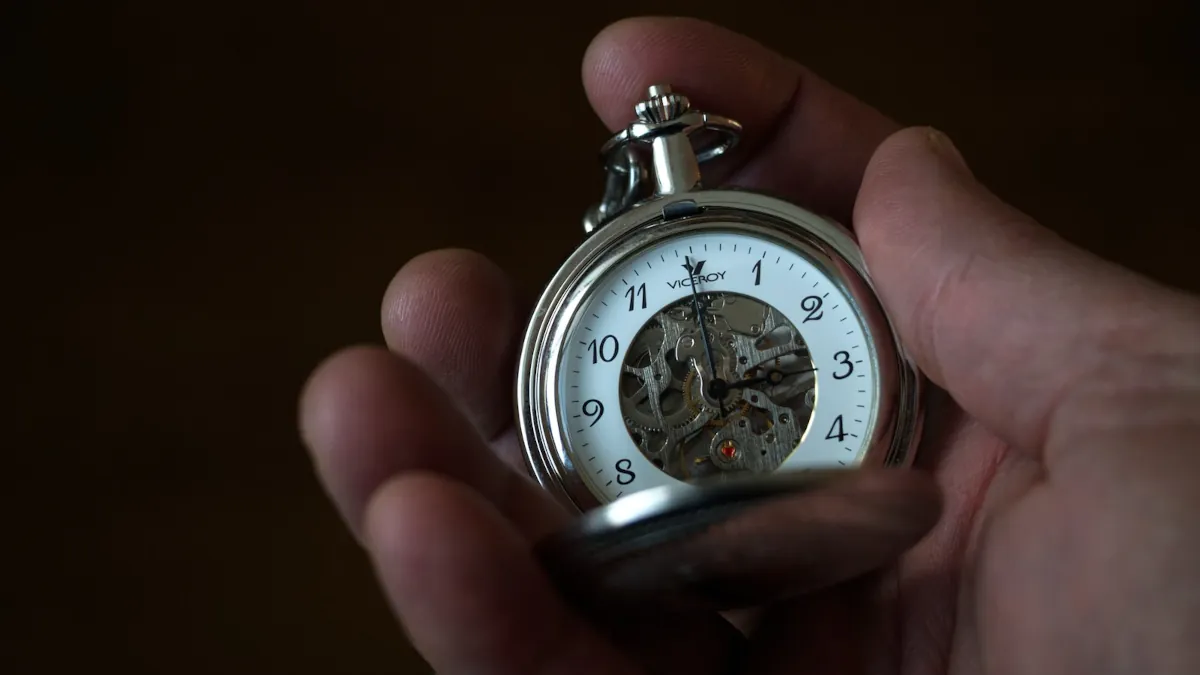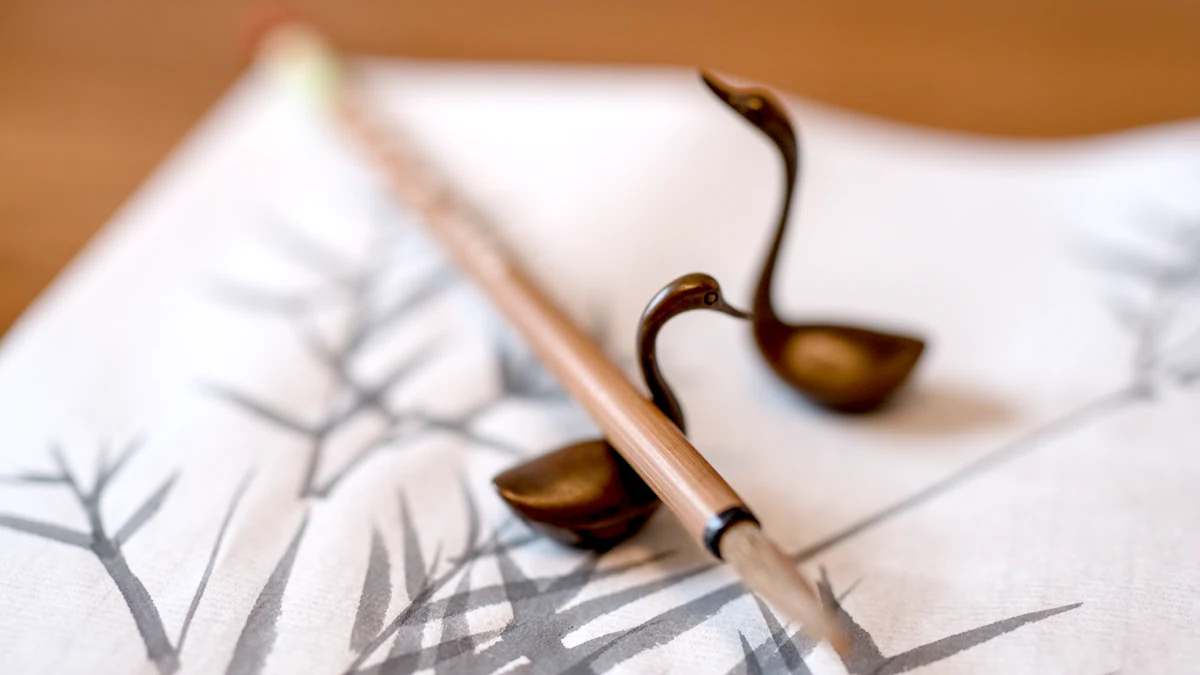
There are brushes on my desk I have been painting with for twenty years. 周虎臣 and 双羊, Zhōu Hǔchén and Shuāng Yáng, working brushes rather than heirlooms, bought long before I could tell the difference, though the first of those houses has been making them since 1694. There is a laptop beside them I will have replaced within three.
I mention the arithmetic because the brushes have taught me more about thinking than every productivity app I have ever built or installed.
When a Saturday morning goes the way it should, before I open the laptop, I grind ink and paint bamboo. By the time the ink is a deep black my breathing has slowed down, and, though I did not realise it for years, my second brain has been quietly humiliated.
I have used Evernote, Notion, Roam, Obsidian and, Logseq. I have built vaults with hundreds of notes, elaborate tag systems, daily notes templates, maps of content, and I have written about all of them. And I will tell you something most PKM evangelists will not: most of those notes, I have never read again. Most of those connections, I have never used. The vault grew. The thinking did not.
It took me a long time to understand why. The answer was sitting on my desk the whole time, in a bamboo jar, bristles up. The problem with the modern second brain is not the tool. It is the architecture. We have built systems for retrieval when what we actually need is systems for internalisation.
Let me show you what I mean.
Store and look up
Quick recap for anyone who has not been swimming in PKM circles for the last five years.
The Second Brain idea, popularised by Tiago Forte, treats your notes app like external memory. You capture everything: articles, ideas, quotes, meeting notes. The system holds it all and, when you need something, hands you the right thing at the right time. The metaphor does the work. Your biological brain is unreliable, the digital one is not. Offload everything. Trust the system.
It is a beautiful idea. It is also, for most people, the productivity equivalent of buying gym equipment that turns into a clothes rack.
Here is the unspoken assumption: knowledge is a thing you store and look up.
That assumption is so deep that we rarely question it. Of course knowledge is stored and retrieved. That is what knowledge is, surely?
No. That is what information is. Information is what you can look up. Knowledge is what you can do without looking. They are not the same thing, and almost every tool in this category is built as though they were.
If you’ve ever had an argument with someone who needed his phone to Google his own stance before responding, you’ll know exactly what I mean.
Ten thousand bamboo leaves
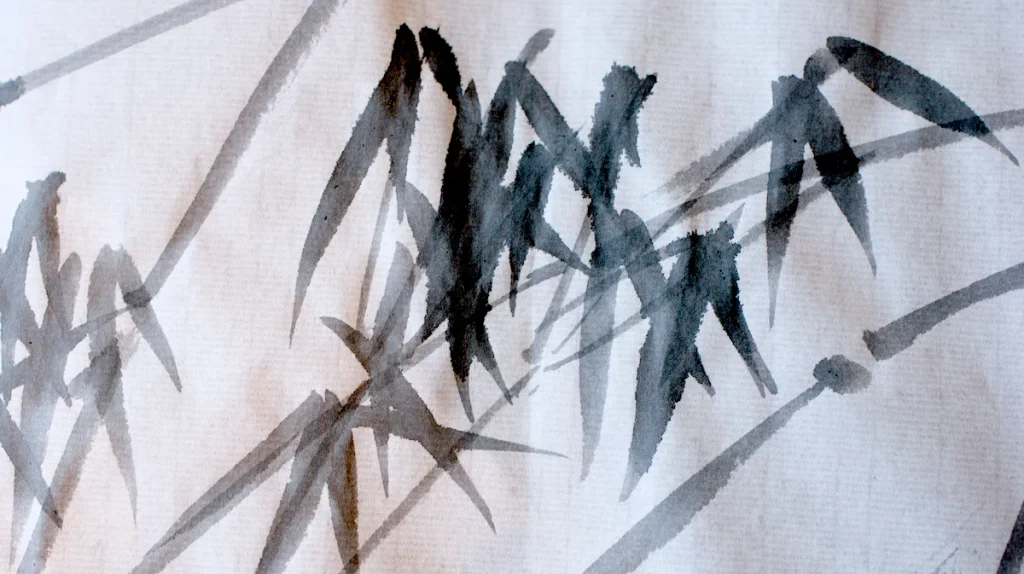
Let me tell you what happens when you learn Chinese brush painting properly. Not the holiday-workshop version, where you produce one wobbly stalk in an afternoon and carry it home in a cardboard tube. The real thing.
You begin, as almost everyone does, with the Four Gentlemen: 四君子, sì jūnzǐ. Plum blossom, orchid, bamboo, chrysanthemum. Four subjects, and that is the entire curriculum for what can easily be the first several years. Between them they contain very nearly every movement the brush will ever be asked to make. The orchid teaches the long sweeping line that thins as it turns. The plum teaches the dry, knotted, broken branch. The chrysanthemum teaches the massed petal. And the bamboo teaches everything at once: a stalk segment is a single loaded stroke, pushed and stopped, and a leaf is one decisive movement that either lands or does not.
You paint them. Not for a week. For months. Years, if you are serious. The same four subjects, the same order of strokes, the same angle of the wrist, until you stop thinking about them and they simply happen.
Here is the thing nobody tells you in PKM forums. After enough painting, the bamboo leaf is no longer in your head. It is in your hand. I do not look up how a leaf is made. I do not consult a reference. I do not need to. The leaf lives in the muscles of my forearm and the angle of my wrist, and my job at the moment of painting is mostly to stay out of its way.
This is not mysticism. It is exactly what neuroscientists call procedural memory, and it is a fundamentally different storage system from the declarative memory we feed our note-taking apps. Procedural memory is what lets you ride a bicycle without thinking about it. It is what lets a martial artist throw a punch without choosing to. It is what lets a painter make a leaf without remembering how, because remembering is no longer involved.
And here is where it gets interesting for productivity people. Procedural knowledge is the only kind of knowledge that actually changes how you live. Everything else is decoration.
Sort by last opened
Now hold that idea up against your Obsidian vault.
What is your vault actually optimised for? Storage and retrieval. You capture an idea, you tag it, you link it, you trust that future-you will find it again when it is needed.
But here is the question that broke my own PKM practice when I finally let myself ask it. How often does future-you actually go looking?
Be honest. Open your vault. Sort by last opened. Look at how many notes from six months ago you have ever returned to.
I made some notes about the four obstacles of Tibetan philosophy months ago and wanted to insert them into a an article I’m writing now. I went to my Zettelkasten to look up the notes, and I did find them. But after reading them and taking a look at the note I linked to (it was irrelevant) I realised that I couldn’t simply copy and paste it, the information wasn’t exactly what I needed for the article. Writing it from scratch would have been faster than the lookup and rewriting.
What we have built, mostly, is a generation of beautifully organised libraries that nobody reads.
What the brush knows
So what does the brush teach that the vault cannot?
Repetition is not redundancy. In PKM culture, writing the same thing twice feels like a failure of the system. Why keep the note in two places? Why duplicate? But you paint the same leaf a thousand times because the painting is the point. Each repetition deepens it. You are not making a copy. You are becoming the thing. The Western productivity instinct is to capture once and retrieve many times. The instinct at the ink stone is to paint many times and internalise once.
Form before freedom. The training in Chinese painting is 临摹, línmó, copying. You copy the old masters, stroke for stroke, for years, and the tradition is entirely unembarrassed about it. Only after that are you trusted with 写意, xiěyì, the loose expressive style whose name means something close to writing the idea. The exactness comes first, and it is what buys the freedom. Compare that to your note-taking. How much of what you captured was structurally sloppy: half-finished thoughts, stub notes, a quote with no annotation? You skipped the copying. You went straight to expressive. The result is a vault full of content with no structure to hold it together. It is graffiti with hyperlinks.
Friction is information. Grinding ink takes five minutes you cannot do anything else with. You cannot grind ink while doomscrolling. You cannot hold a brush properly while distracted. And then there is the paper: 宣纸, xuān zhǐ, which drinks the ink on contact. There is no correction. No overpainting, no lifting, no second attempt on the same sheet. A stroke you regret is a sheet in the bin. Every note-taking app I have ever used has infinite undo, and I have come to think that infinite undo is exactly why nothing inside them is ever decided. Friction is not the enemy of thought. Friction is what turns information into knowledge.
The body is part of the system. There is an old formulation that ink divides into five shades: 墨分五色, mò fēn wǔ sè. Burnt, thick, heavy, pale, clear. One stick of black. Nothing in the material changes between them. What changes is how much water you carried, how hard you pressed, how fast you moved, how long you waited before the next stroke. The entire range lives in the body, and none of it is in any notebook. None of it can be. This is the part that took me longest to accept, after twenty years in Asia and thirty years on the mat. Most knowledge worth having is not stored in language, and anything not stored in language cannot be stored in a notes app.
The four-place brain
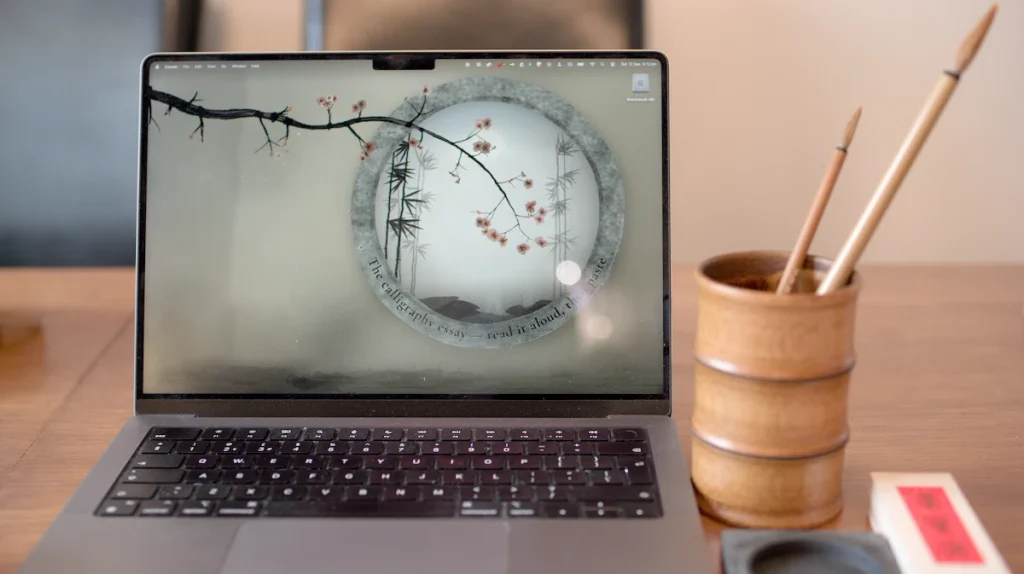
So what do you do? Throw out Obsidian? Burn the vault?
No. But you change what the vault is for.
In the model I have settled on after two decades of trying everything, the digital second brain is not the main system. It is the index. The actual knowledge, the kind that changes how I work, write, train and live, sits in four places, and only one of them is on a computer.
The body. Habits, skills, reflexes. Built by repetition. No app required.
The page. A physical notebook for copying and reflection and a stack of xuan paper for slow thinking. Slow input, high retention.
The conversation. Knowledge that gets used in dialogue gets internalised by the act of explaining it. Most of mine happens at work, explaining a system to the people who will have to live inside it, and a growing amount of it now happens out loud to an AI at six in the morning. The machine does not push back the way a colleague does, and I would not pretend otherwise. But the explaining still does its work, because the explaining was always the point.
The vault. A reference library for the things I do not need to internalise: links, source quotes, project files. The library, not the brain.
The mistake was treating the vault as the brain. It is not. It is the bookshelf in the corner of a room where the actual thinking happens elsewhere.
The bamboo in your chest
There is a phrase in Chinese that gets used now for ordinary confidence, the way an English speaker might say they have it all worked out. 胸有成竹, xiōng yǒu chéng zhú. To have the completed bamboo in your chest.
It comes from Su Shi, writing in the eleventh century about his friend Wen Tong, who painted bamboo better than anyone then alive. To paint bamboo, Su Shi said, you must first have the finished bamboo within you. The painting is not composed on the paper. It is already whole before the brush is loaded, and the brush arrives only to confirm it.
I do not think anyone has written a better description of what a knowledge system is supposed to do in the thousand years since.